Platform
How It Works The Living Model Nous Mneme Phronesis Praxis Taxis Metron
Solutions
LNG & Natural Gas Terminals Pipeline Operations Maritime & Port Operations Petroleum & Chemical Terminals Electric Utilities Emergency Management
Company
About Careers FAQ Contact Us
Knowledge Base
Case Studies White Paper Resources Book a Walkthrough
Part I — The Incident
Incident Summary

At 7:15 AM on May 26, 2026, a 900,000-gallon white liquor tank imploded at the Nippon Dynawave Packaging Co. facility in Longview, Washington. Eleven workers were killed. Seven facility workers and one firefighter were injured, several critically. White liquor — a highly corrosive alkaline solution of sodium hydroxide and sodium sulfide — contaminated the facility site, the surrounding ditch network, and reached the Columbia River. The incident is Washington State's deadliest industrial disaster since 1930.

CSB investigation opened May 27. Washington Department of Labor & Industries investigation active, 180-day deadline November 22. Washington State will bill Nippon Dynawave for full response costs. Class action litigation expected.

What Happened

Just after 7 AM on May 26, 2026, workers at the Nippon Dynawave Packaging Co. facility in Longview, Washington were beginning the morning shift. The facility — a kraft pulp and paper mill that produces eight billion single-serve food containers annually — had been operating on this site since 1953. Nippon Paper Industries, the Japanese parent company, had acquired it in 2016.

At 7:15 AM, the G Tank — a 900,000-gallon storage tank containing white liquor — imploded. White liquor is a highly corrosive alkaline solution of sodium hydroxide and sodium sulfide used in the kraft papermaking process to break down wood chips into pulp. The implosion was visible from the highway. The structural damage was immediate and catastrophic.

Eleven workers were killed. Seven facility workers and one firefighter suffered burns and inhalation injuries, several critically. Multiple workers were transported to the Legacy Oregon Burn Center in Portland. The rescue operation shifted to a recovery operation within 24 hours.

The Multi-Agency Response — Six Simultaneous Emergencies

A white liquor release into a mixed industrial/residential corridor on the Columbia River is not one emergency. It is six simultaneous emergencies with six different agency leads, six different reporting chains, and zero time to build the playbook from scratch.

Agency Jurisdiction Immediate Demand
Washington Dept. of Ecology State water quality, environmental contamination, spill response Containment status, ditch network monitoring, Columbia River pH levels, community notifications
U.S. EPA Columbia River, CERCLA, federal environmental oversight River contamination assessment, pH monitoring, drinking water status, air quality monitoring
Longview Fire Dept. + Cowlitz Fire & Rescue Emergency response, HAZMAT operations, rescue and recovery Chemical profile of white liquor, HAZMAT staging, tank stabilization before recovery operations
Washington Dept. of Labor & Industries Worker safety investigation, OSHA equivalent authority Fatality notification (8-hour clock), incident documentation, access to facility records
U.S. Chemical Safety Board Federal chemical accident investigation Opened investigation May 27. Investigators on-site within 48 hours. Full report expected spring 2027.
Cowlitz Indian Tribe Columbia River tribal rights, environmental sovereignty River quality data, tribal notification, coordination with cleanup operations

In addition: the Governor's office, Nippon Paper Industries executives in Japan, families of the missing, media already at the dike, and a community of 40,000 people watching the smoke rise from a facility that had been operating for 73 years.

The job of the Incident Responder under pressure is not to be heroic. It is to be steadfast, accurate, and methodic — with a record that proves it.
Part II — The Coordination Gap

The First Thirty Minutes

In the first thirty minutes after the G Tank imploded, the Incident Commander faced a sequence of demands that no human being can navigate from memory, a binder, or improvised coordination:

None of these questions have answers that can be assembled under pressure from a binder on a shelf. They have answers that must exist before the event — encoded, verified, and immediately retrievable the moment the sensor fires and the phone starts ringing.

The Documentation Gap That Follows

The emergency lasted 37 days. What follows will last a decade.

The CSB investigation is active. The Washington Department of Labor & Industries investigation has a November 22 deadline. OSHA will review every document related to the facility's safety program. Class action litigation from families of the eleven is likely. Workers' compensation claims will compound. Insurance carriers are reviewing every policy and every gap in the documented response. Washington State will bill Nippon Dynawave for the full cost of the six-agency, 37-day response operation.

And Nippon Paper Industries — a Japanese parent company with a North American mill operation — is managing reputational damage in two countries simultaneously.

What the Investigation Will Ask
  • Not whether Nippon Dynawave had an emergency response plan. They did.
  • Whether the plan reflected the actual facility — current personnel, current chemical inventory, current command structure.
  • Whether the response followed the plan — and whether there is a timestamped, attributed record proving it.
  • Whether the notification chain was documented in real time — or reconstructed afterward from memory and email chains.
  • The gap between documented doctrine and actual response behavior is where regulatory exposure compounds, litigation exposure widens, and insurance coverage narrows.
Part III — What CROS Would Have Addressed

The following describes what CROS would have surfaced had it been deployed at Nippon Dynawave Packaging Co. before May 26, 2026. This is not a retrospective claim of deployment. It is a demonstration of the architecture against the documented facts of the incident.

Before the Event — The Living Model

CROS does not activate when the sensor fires. It has been running. The Living Model encodes the facility's operational reality continuously — command structure, chemical inventory, regulatory obligations, vendor qualifications, SOPs, personnel accountability, and notification chains. When the G Tank implodes at 7:15 AM, the system already knows:

Pre-Loaded in the Living Model — Instantly Accessible at Incident Declaration
📐 Floor Plan
Facility layout, zone boundaries, evacuation routes, hot/warm/cold zone designation
👥 Roster
Current shift personnel, contractors, visitors — accountability baseline for recovery operations
⚗️ Chemical Inventory
White liquor profile, threshold quantities, IDLH values, CERCLA reportable quantities — pre-loaded, not looked up
⫏ HVAC Layout
Airflow diagrams, ventilation zones, isolation points — critical for H₂S liberation management
☎️ LEPC Contacts
Local Emergency Planning Committee — pre-loaded with direct lines, not main numbers. EPCRA 304 notification ready to dispatch
🗺️ Facility Map
Site map with tank locations, utility lines, access points, Columbia River proximity and stormwater pathways
📊 Common Operating Picture
CAM sensor overlay, community zone status, regulatory clock wall, life safety prioritization — one screen, IC-commanded
🏷️ Vendor Readiness
HAZMAT contractor insurance status, contact currency, tier classification — verified on a 30-day cadence, not looked up under pressure

None of this is assembled under pressure. It is retrieved. Ground first. Govern second.

And from the moment the event is declared, everything flows the other direction simultaneously. Every action taken, every confirmation logged, every notification dispatched, every resource accessed is captured by Mneme — append-only, inviolable, in sequence. The response and the record are not two separate activities. They are the same event. By the time Unified Command deactivates on July 1 — 37 days after the G Tank imploded — the operational memory of the entire response exists as a complete, unmodified, producible record. Not reconstructed. Not assembled from email chains and handwritten notes. Built continuously, in real time, from the first sensor event to the final agency notification.

During the Event — What CROS Generated

Classified and sequenced within seconds of incident declaration.

Life Safety Actions — Sequenced and Gated

Regulatory Timers — Pre-Loaded and Running

Six regulatory clocks, pre-loaded contacts, and classified severity — surfaced within seconds of the event declaration. Not assembled under pressure. Retrieved from the Living Model built before the G Tank imploded.

Every action the IC confirms is logged to the incident thread — timestamped, attributed, append-only. The response record is building itself in real time. Not to be reconstructed afterward. Not to be assembled from memory under deposition. It exists.

"Assume criminal referral potential from the outset" is doctrine, not improvisation. CROS surfaces it because it was encoded. A binder does not.

CROS Command — Live System Output

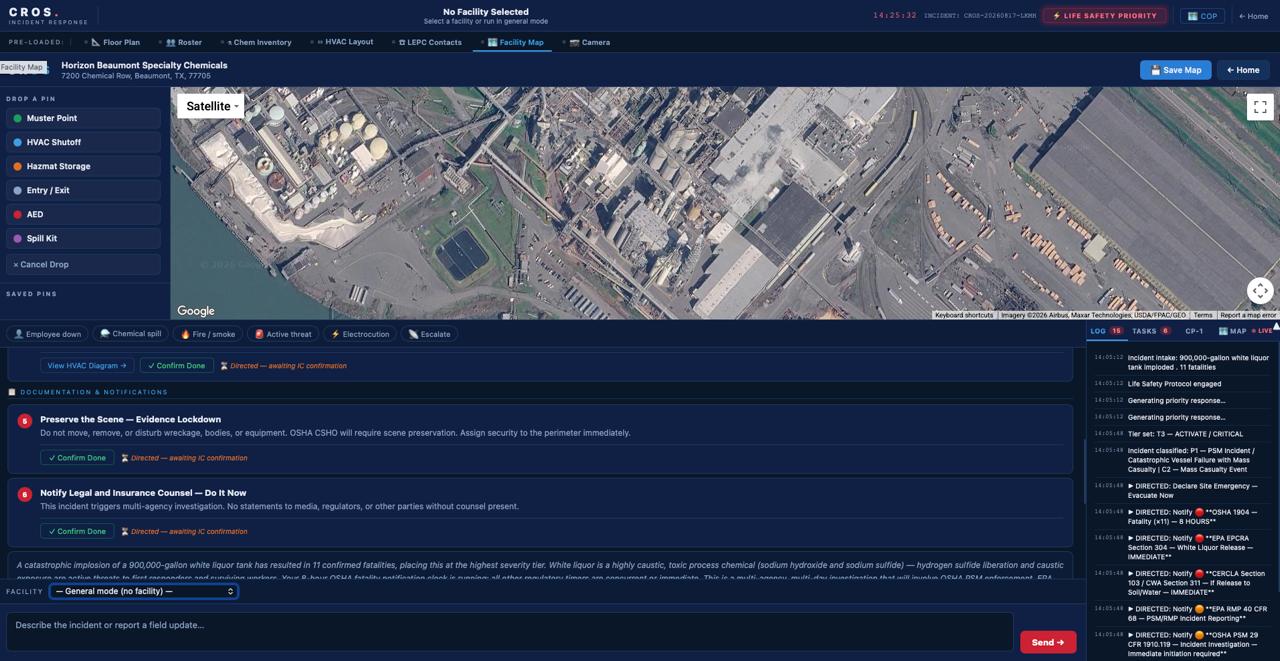
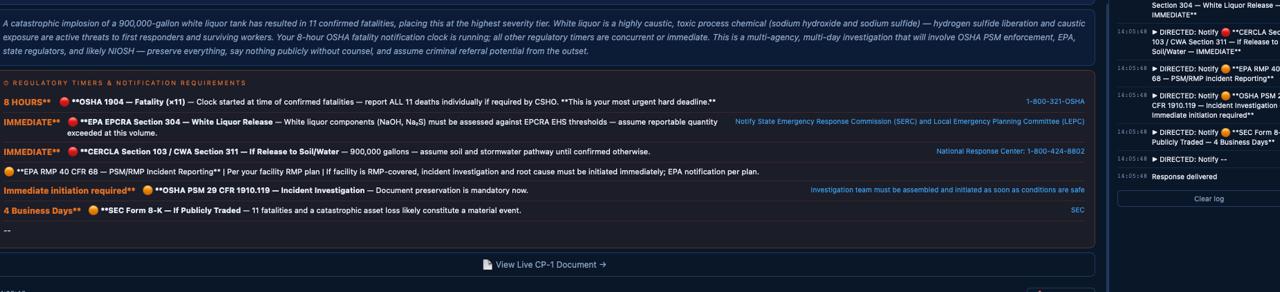
The following screens show CROS Command running the Nippon Dynawave scenario in real time. All screenshots are simulated — general facility mode, no named facility profile loaded. When a facility is onboarded, all pre-loaded assets, chemical inventory, roster, and map reflect that specific facility.
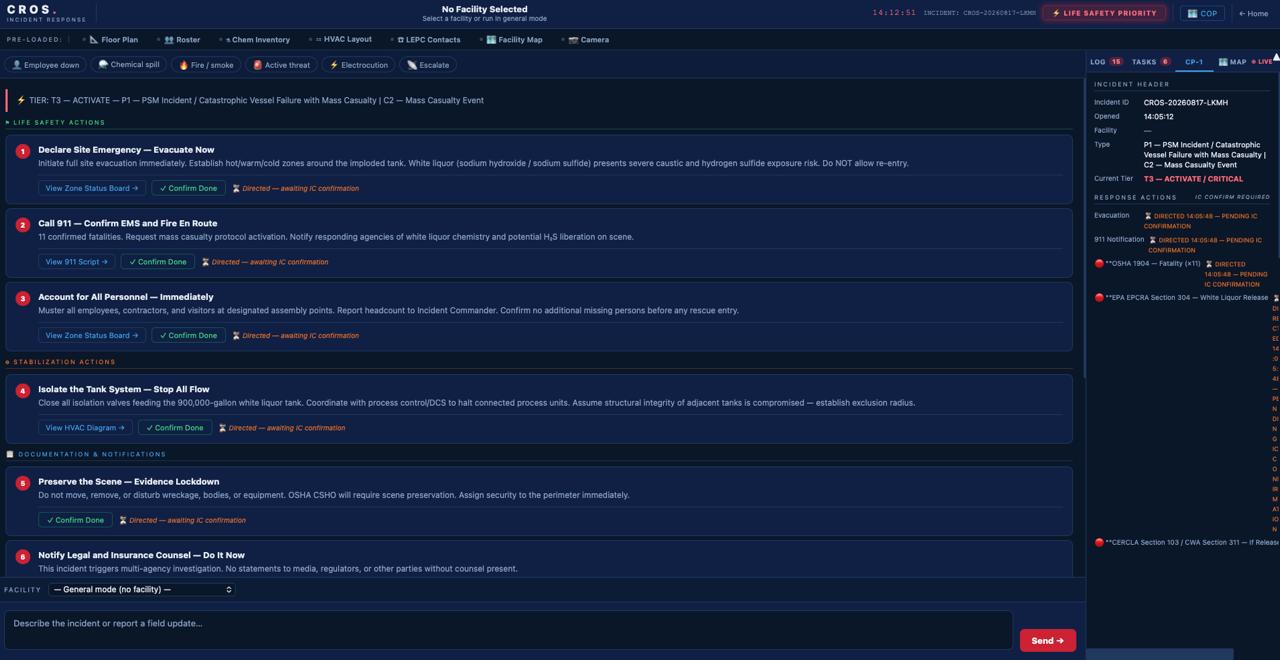
Screen 1 — Incident Command Interface
CROS Command — Incident declared, T3 Activate, six sequenced life safety actions
CROS Command — Incident declared. T3 Activate / Critical. Six sequenced life safety and stabilization actions with IC confirmation gates. Response Actions panel shows IC CONFIRM REQUIRED on every notification. Simulated scenario — general facility mode.
↗ Click to enlarge
Screen 2 — Regulatory Timer Stack and Incident Log
Regulatory timer stack with six-clock sequence and incident log
Regulatory timer stack with color-coded urgency. 36 seconds from incident intake to six regulatory notifications directed. Incident log on right shows full sequence timestamped from 14:05:12. CP-1 Document building in real time. Simulated scenario — general facility mode.
↗ Click to enlarge
Screen 3 — Facility Map View with Incident Log
Facility map with satellite imagery and incident log running simultaneously
Facility Map with satellite imagery. Pin categories: Muster Point, HVAC Shutoff, Hazmat Storage, Entry/Exit, AED, Spill Kit. Incident log running simultaneously on right panel. Simulated scenario — general facility mode.
↗ Click to enlarge
After the Event — The Record That Defends You

When the lawyers arrive, the record answers before you do.

When the CSB arrives, when Washington L&I serves notice, when the plaintiff's attorneys file — the question is not what happened. It is what you knew, when you knew it, what you did, and whether you can prove it.

When PHMSA shows up, you don't reconstruct. You produce. When the lawyers arrive, the record answers before you do.

The Doctrine Delta — Before the Next Event

The CSB's preliminary findings are expected before end of September 2026. The full report arrives in spring 2027. What it will document is not simply what failed mechanically. It will document the gap between the facility's documented safety program and what the operational record shows actually happened — the drift between policy and practice that accumulated before the G Tank imploded.

Phronesis monitors that gap continuously — as operational data accumulates. The Doctrine Delta is not a static audit. It is the living comparison between encoded doctrine and the operational record that builds with every incident, near-miss, drill, and corrective action. For a new deployment, this intelligence layer activates and deepens as the organization's operational history grows. For Nippon Dynawave, five years of operational history would have fed it. The Doctrine Delta surfaces before the investigation. Before the next event. Before the next tank fails.

A documented known gap with no corresponding control is an open item in the Living Model that cannot be archived without a named owner and a resolution. The gap between what your procedures say and what your operational record shows is where regulatory exposure accumulates silently — long before any declared event. CROS surfaces it. Continuously. Before regulators do.

If your facility's emergency response plan lives in a binder on a shelf, we should talk.

A protocol walkthrough is a live session — we load your facility type, run a scenario against your regulatory stack, and show you exactly what CROS surfaces in the first thirty minutes of a declared event.

Book a Walkthrough →